
Unleash RAPTOR
A Simple Six-Part Framework for Talking With AI

So you want to use tools like ChatGPT or Claude – and use them well?
I’m not an AI expert (but I did stay at a Holiday Inn Express last night) but I do use these tools frequently. What distinguishes exceptional AI interactions from merely adequate ones often lies not in the complexity of our requests, but in the clarity of our communication architecture.
Over time, I created a simple framework to prompt LLMs for the best results. It’s not for every task – not a all – but it does seem to produce useful results quickly. Plus, I asked ChatGPT4o3-mini-high what it thought of the framework it said “this should be extremely helpful”. So there’s that.
I call it the RAPTOR framework:
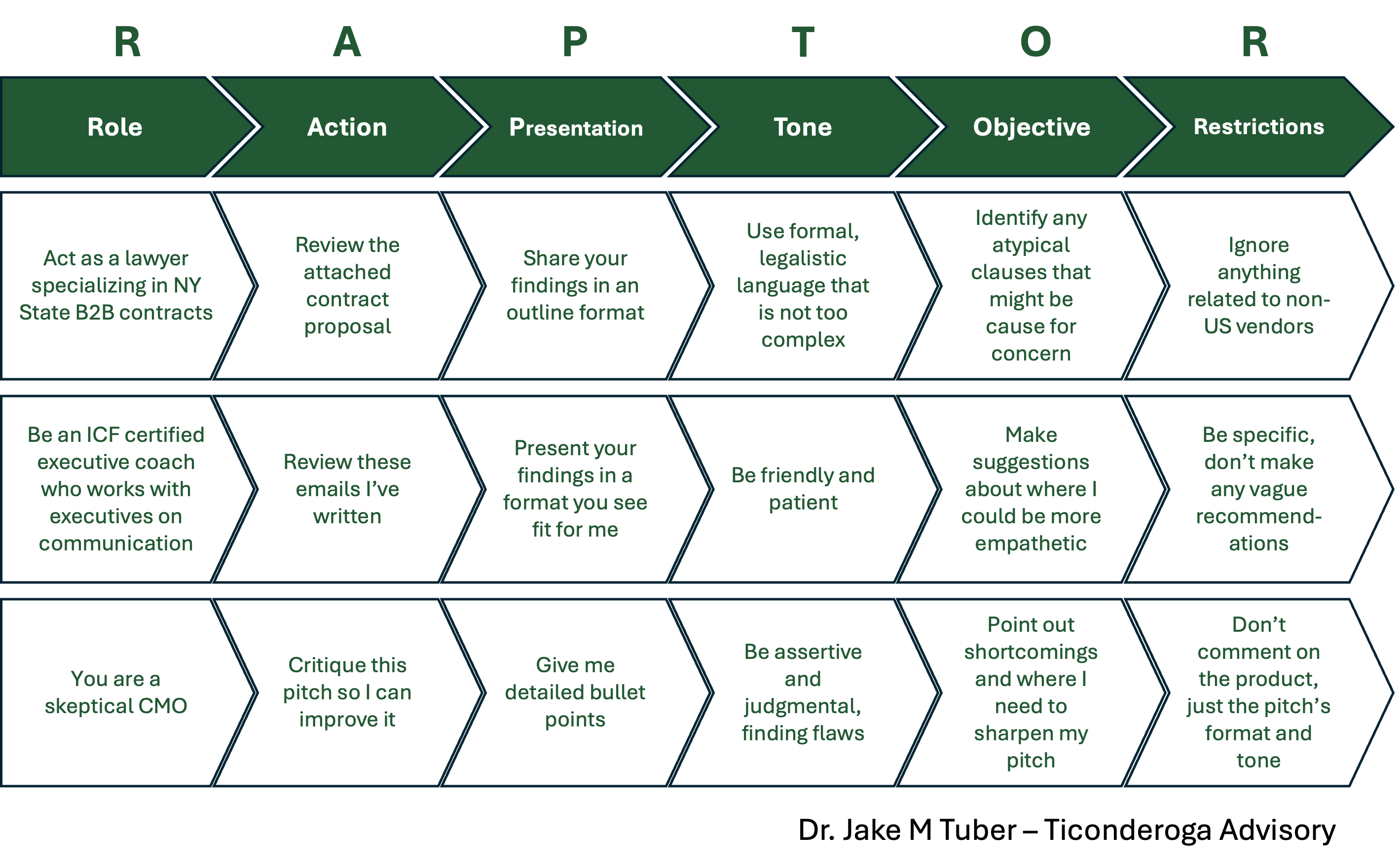
The RAPTOR framework provides this architecture through six essential elements:
Role: The Foundation
Tell the AI to embody a role. Whether you're asking the AI to act as a specialized lawyer or a certified executive coach, this foundational step shapes every subsequent interaction.
Action: The Clarity of Purpose
The framework's second element focuses on explicit task definition. What do you want it to do for your right now? Rather than assuming shared understanding, successful prompts clearly articulate what needs to be reviewed, analyzed, or created. This precision eliminates the ambiguity that often plagues AI interactions.
Presentation: Make the Output Useful
The presentation element guides us to specify not just what we want, but how we want it delivered - whether in outline format, detailed bullet points, or another structure that serves our purpose. Instructions like “produce your results in a table format that I can easily copy/paste into PowerPoint” can work wonders.
Tone: The Voice of Interaction
Perhaps the most nuanced element, tone setting can transform identical content into radically different messages. From formal legalistic language to friendly patience, or assertive judgment, the tone we specify shapes how information is received and processed. You can skip this if you truly don’t care. Or you can always go back and ask for output in a different tone, too.
Objective: The Goal Beyond the Task
This element gives the AI some context of why you’re asking it to perform the stated action. What’s the reason behind the ask? I’ve found this can help inform it’s results if it knows what you’re trying to achieve more broadly. I’d bet the latest reasoning models (o1, o3, etc.) make this even more effective.
Restrictions: Set Limits
Counter-intuitively, limitations often enhance creativity and precision. By explicitly stating what to exclude or avoid, we create clearer boundaries for more focused and relevant responses.

What fascinates me most about RAPTOR is how it mirrors principles of effective human communication while acknowledging the unique characteristics of AI interaction. Through countless iterations and applications, I've found that this framework consistently elevates the quality of my AI collaboration.
However, I designed this framework to optimize the classic LLMs rather than the newest reasoning models (e.g. ChatGPT4o3). It still works very well with reasoning models, though I suspect I’ll soon discover worthwhile differences.
Try it out! Let me know what you think – please!
That's it for this edition - please reach out if I can be at all helpful.
Be compassionate and intentional.