
Giving Feedback? Avoid the 'Feedback Sandwich'
And stop insulting Oreos.

It’s performance review season (champagne pops!). Many of you readers are undoubtedly giving and receiving formal feedback at work. In light of this timely affair, I’m touching-up and republishing an old newsletter about what not to do when giving performance feedback…

Don't Eat That Sandwich!
You've heard of the "feedback sandwich" before.
It's where you start off feedback with something positive, followed by something constructive (what you really wanted to convey), and finish with something positive to end on a good note. Sandwiching the harsh feedback between the good stuff makes it more palatable. Apparently.
Don't give feedback this way.
There are far better methods for giving feedback. The sandwich approach is always suboptimal.
Why? The specific reasons depend on the psychological sophistication of the recipient.

[I've also erroneously heard this referred to as the "feedback Oreo" and as I discuss in this podcast episode, I take particular offense to the notion that the cream filling is somehow the "harsh" stuff. Every part of an Oreo is perfect - end of story.']
Some experts, such as the folks at the World of Work Project, cite a common criticism of the sandwich approach: All the "good stuff" will drown out the constructive feedback. The key part of the message – the "harsh" part in the middle of that sandwich – will be lost on an under-performer.
That is probably true for an employee who struggles with any negative criticism. They might downplay the constructive criticism to maintain an illusion of themselves. Alternatively, they might over-fixate on the constructive criticism and dwell in negativity, which would also hamper their performance going forward.
But what about the more emotionally savvy employee who is able to tolerate constructive feedback? You know… most of us.
Well, we might still fall victim to overemphasizing the sandwich bread slices at the expense of the constructive parts in the middle.
It’s worth remembering that positioning the positive messaging first and last plays right into the hands of anchoring and recency biases. But for those more sophisticated individuals (most of us) I suspect there's another reason the sandwich approach is suboptimal: We know the game.
You're not fooling anyone.
The average person of moderate emotional intelligence knows that we're really trying to deliver the "harsh" stuff in as generous a way possible. They might know this because the sandwich approach is widely known. Heck, they probably use it themselves!
Or more simply, upon hearing sandwiched feedback, they interpret us as trying to butter-them-up-for-bad-news and later trying to send-them-off-feeling-good. To the average person, the feedback sandwich is at best a well-intended but unimpressive maneuver. At worst, it might be perceived as outright condescending.
This all reveals a fundamental truth about the feedback sandwich: It's designed to for the provider, not the recipient. We use the feedback sandwich to make it easier for us to give constructive feedback because it’s uncomfortable for us. We’ve told ourselves it helps the recipient, when in fact, it’s all for us.

So if the sandwich is poisoned, what should we do instead
There are a variety of more helpful frameworks for feedback (SBI, COIN/COILED, CEDAR and many others) that all have a few common elements:
Begin by setting the context for the conversation.
Next, describe the facts of what was observed and connect those observed behaviors to their impact on performance.
Finally, make a plan to move forward.
A version I developed and teach is the SAID Framework:
Situation (when/where)
Action (what they did—observable)
Impact (what it caused)
Do next (request/agreement)
You can see an example with each component called out here:
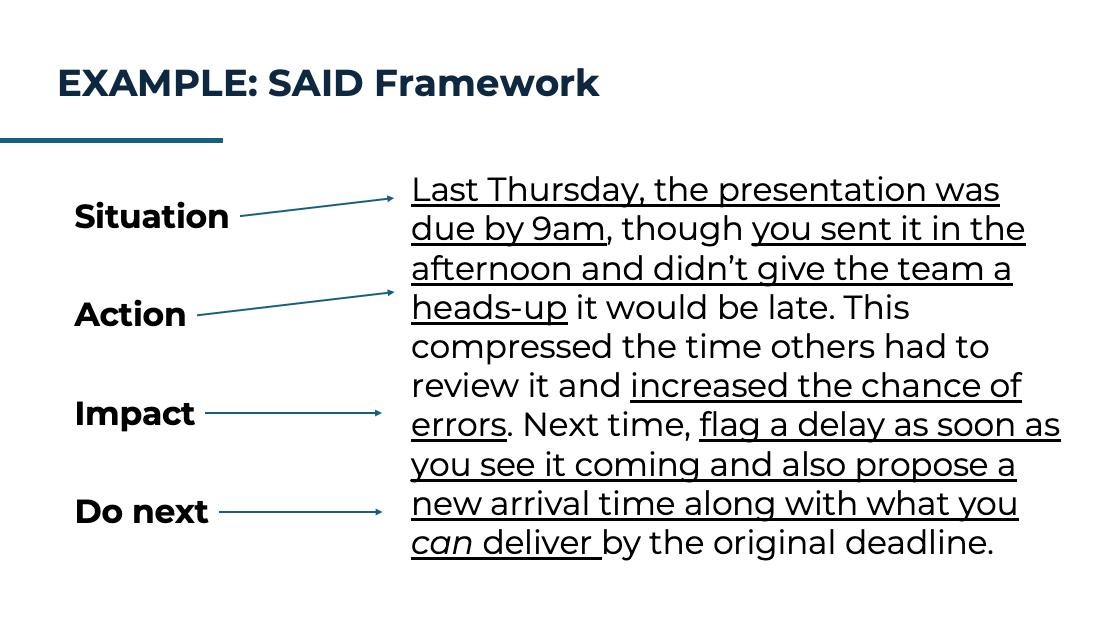
Most frameworks will correctly stress that the impact component is critical. Connecting the recipient's actions to their impact/outcomes is crucial in generating ownership and creating buy-in for improvement.
However, I think there's an opportunity for further tailoring. Ideally, we can cite the type of impact most likely to resonate with the recipient.
For example, some employees may be truly motivated by seeing the financial impact of their actions at the organization-wide level. Others may be more driven by how their actions impacted their team members, or their manager's perception of them, or their chances at a promotion, or their personal bonus, etc.. A little precision can go a long way.
That's where data from assessment tools can come in handy. Whether you’re utilizing a simple framework like social-styles or DISC, or deploying sophisticated psychometrics like the Hogan Motives, Values, and Preferences Inventory, these tools give us insight into type of impact statements will be most likely to land with the recipient.
So when you're giving feedback, avoid the sandwich. Instead, utilize an approach that is more direct and prescriptive. Tailor it to the motivations of the recipient whenever possible. And even though you’re looking backwards, focus on what they’ll do going forward. You can’t change the past.
That's it for this edition - please reach out if I can be at all helpful.
Be compassionate and intentional.